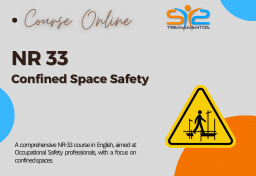
This course provides comprehensive training on safe entry and monitoring of confined spaces, fully aligned with the Brazilian Ministry of Labor Standard NR‑33 – Safety and Health in Confined Spaces.
It is designed for workers who will enter confined spaces and for those who will act as the attendant (watchman) responsible for monitoring and ensuring the safety of the operations.
The course combines theory, hazard awareness, safe work practices, atmospheric monitoring, permit procedures, emergency response, and communication protocols. It includes basic quizzes at the end of each lesson to reinforce knowledge retention.
General Objective
Enable workers and attendants to identify confined spaces, recognize hazards, follow NR‑33 requirements, use protective equipment, apply safe entry procedures, perform monitoring activities, and respond appropriately to emergencies.
Specific Objectives
By the end of the course, participants will be able to:
- Understand the regulatory requirements of NR‑33.
- Recognize confined spaces and their associated hazards.
- Apply safe entry procedures, including permits, isolation, and atmospheric testing.
- Understand roles and responsibilities of Entrants, Attendants, and Supervisors.
- Use PPE and safety equipment correctly.
- Maintain communication and monitoring during confined space operations.
- Act safely in abnormal conditions and report deviations immediately.
- Understand the basics of emergency response (non‑entry and entry rescue).
- Support a culture of safety in confined space operations.
────────────────────────────────────
Course Program – 16 Hours
Structured in Lessons (for LMS / e-learning platforms)
Each lesson ends with a basic quiz.
Lesson 1 – Introduction to Confined Space Safety (1h)
- Definition of confined space (NR‑33)
- Characteristics: limited entry/exit, restricted ventilation, hazardous potential
- Importance of confined space safety
- Accident statistics and common causes
- Regulatory overview: NR‑33 framework
Quiz 1 – Basic concepts
Lesson 2 – Roles and Responsibilities (1h)
- Authorized Entrant
- Attendant (Watchman)
- Entry Supervisor
- Employer responsibilities
- Communication and teamwork requirements
Quiz 2 – Roles and duties
Lesson 3 – Hazard Recognition in Confined Spaces (2h)
- Atmospheric hazards
- Oxygen deficiency and enrichment
- Flammable gases and vapors
- Toxic agents (H₂S, CO, solvents, vapors)
- Physical hazards
- Engulfment, entrapment, engulfing materials
- Mechanical, electrical, thermal risks
- Noise, vibration, slips, falls
- Biological hazards
- Behavioral and organizational factors
Quiz 3 – Hazard identification
Lesson 4 – Atmospheric Testing & Monitoring (2h)
- Purpose of atmospheric testing
- Types of detectors
- Calibration and bump test
- Testing sequence (O₂ → flammability → toxicity)
- Continuous monitoring requirements
- Interpretation of readings and alarm levels
Quiz 4 – Atmospheric monitoring
Lesson 5 – Control Measures and Risk Reduction (2h)
- Isolation of energy sources (LOTO)
- Ventilation techniques
- Purging and inerting
- Barriers and signaling
- Hot work precautions
- Safe use of tools and equipment
Quiz 5 – Control measures
Lesson 6 – Confined Space Entry Permit (1h)
- Purpose of the entry permit
- Required information (NR‑33 requirements)
- Roles in permit authorization
- Validity, cancellation, and records
- Pre‑entry checklist
Quiz 6 – Permit system
Lesson 7 – Personal Protective Equipment (PPE) and Safety Equipment (1h)
- Respiratory protection: filters, SCBA, airline systems
- Fall protection: harnesses, lifelines, tripods
- Communication devices
- Illumination and intrinsically safe equipment
- Maintenance and inspection
Quiz 7 – PPE and equipment
Lesson 8 – Attendant (Watchman) Duties (1h)
- Continuous monitoring of entrants
- Prohibited behaviors for attendants
- Communication methods
- Warning signs and emergency triggers
- When to stop the entry procedure
Quiz 8 – Attendant responsibilities
Lesson 9 – Safe Entry Procedures (2h)
- Pre‑entry briefing
- Work authorization
- Step‑by‑step entry process
- Monitoring during the activity
- Documentation and reporting
- End‑of‑work procedures
Quiz 9 – Safe entry steps
Lesson 10 – Emergency Response & Basic Rescue Principles (2h)
- NR‑33 rescue requirements
- Non‑entry vs. entry rescue
- Duties of the attendant during emergencies
- Use of retrieval systems
- Understanding rescue plans (but NOT replacing rescue team training)
- Coordination with emergency teams
Quiz 10 – Emergency response
Lesson 11 – Practical Case Studies & Good Practices (1h)
- Real accident case analysis
- Decision‑making for entrants and attendants
- Positive and negative examples
- Safety culture reinforcement
Quiz 11 – Case review
Lesson 12 – Course Review & Final Assessment (1h)
- Summary of key concepts
- Review of main NR‑33 requirements
- Final evaluation (quiz or test)
- Feedback and closing remarks
Final Quiz – Overall Knowledge
Características do curso
- Palestras 40
- Questionário 0
- Duração 20 semanas
- Nível de habilidade Todos os níveis
- Linguagem Inglês
- Estudantes 19
- Certificado Sim
- Avaliações Sim
- 11 Seções
- 40 Lições
- 20 Semanas
- Lesson 1 – Introduction to Confined Space Safety5
- Lesson 2 – Roles and Responsibilities4
- Lesson 3 – Hazard Recognition in Confined Spaces7
- Lesson 4 – Atmospheric Testing & Monitoring4
- Lesson 5 – Control Measures and Risk Reduction4
- Lesson 6 – Confined Space Entry Permit3
- Lesson 7 – Personal Protective Equipment (PPE) and Safety Equipment3
- Lesson 8 – Attendant (Watchman) Duties2
- Lesson 9 – Safe Entry Procedures3
- Lesson 10 – Emergency Response & Basic Rescue Principles3
- Lesson 11 – Course Review & Final Assessment2